
Fats
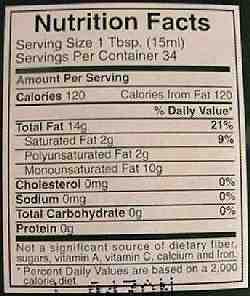
We all know about the common fats that different foods contain. Meat contains animal fat. Most breads and pastries contain vegetable oils, shortening or lard. Deep fried foods are cooked in heated oils. Fats are greasy and slick.
You commonly hear about two kinds of fats: saturated and unsaturated. Saturated fats are normally solid at room temperature, while unsaturated fats are liquid at room temperature. Vegetable oils are the best examples of unsaturated fats, while lard and shortening (along with the animal fat you see in raw meat) are saturated fats. However, most fats contain a mixture. For example, above you see the label from a bottle of olive oil. It contains both saturated and unsaturated fats, but the saturated fats are dissolved in the unsaturated fats. To separate them, you can put olive oil in the refrigerator. The saturated fats will solidify and the unsaturated fats will remain liquid. You can see that the olive oil bottler even chose to further distinguish the unsaturated fats between polyunsaturated and monounsaturated. Unsaturated fats are currently thought to be more healthy than saturated fats, and monounsaturated fats (as found in olive oil and peanut oil) are thought to be healthier than polyunsaturated fats.
Advertisement
Fats that you eat enter the digestive system and meet with an enzyme called lipase. Lipase breaks the fat into its parts: glycerol and fatty acids. These components are then reassembled into triglycerides for transport in the bloodstream. Muscle cells and fat (adipose) cells absorb the triglycerides either to store them or to burn them as fuel.
You need to eat fat for several reasons:
- As we will see in the next section, certain vitamins are fat soluble. The only way to get these vitamins is to eat fat.
- In the same way that there are essential amino acids, there are essential fatty acids (for example, linoleic acid is used to build cell membranes). You must obtain these fatty acids from food you eat because your body has no way to make them.
- Fat turns out to be a good source of energy. Fat contains twice as many calories per gram as do carbohydrates or proteins. Your body can burn fat as fuel when necessary.
For more information about fat in the diet, check out the links at the end of this article.