Mushroom Facts
- France was
the first country to cultivate mushrooms, in the mid-17th century. From
there, the practice spread to England
and made its way to the United
States in the 19th century.
- In
1891, New Yorker William Falconer published Mushrooms: How to Grow Them--A
Practical Treatise on Mushroom Culture for Profit and Pleasure, the first
book on the subject.

2008 HowStuffWorks
Delicious fungi - In North America alone, there are an estimated 10,000
species of mushrooms, only 250 of which are known to be edible.
- A
mushroom is a fungus (from the Greek word sphongos, meaning
"sponge"). A fungus differs from a plant in that it has no
chlorophyll, produces spores instead of seeds, and survives by feeding off
other organic matter.
- Mushrooms
are related to yeast, mold, and mildew, which are also members of the
"fungus" class. There are approximately 1.5 million species of
fungi, compared with 250,000 species of flowering plants.
- An
expert in mushrooms and other fungi is called a mycologist--from the Greek
word mykes, meaning "fungus." A mycophile is someone whose hobby
is to hunt edible wild mushrooms.
- Ancient
Egyptians believed mushrooms were the plant of immortality. Pharaohs
decreed them a royal food and forbade commoners to even touch them.
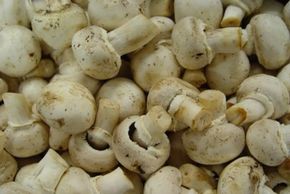
- White agaricus (aka "button") mushrooms are by far the most popular, accounting for more than 90 percent of mushrooms bought in the United States each year.
More Mushroom Facts
- Cultivated
mushrooms are agaricus mushrooms grown on farms. Exotics are any farmed
mushroom other than agaricus (think shiitake, maitake, oyster). Wild
mushrooms are harvested wherever they grow naturally--in forests, near
riverbanks, even in your backyard.

Will Heap/Getty Images
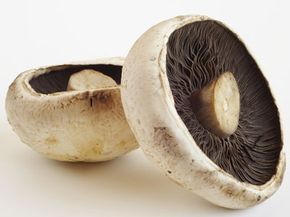
Brown agaricus mushrooms include cremini and portobellos, though they're really the same thing: Portobellos are just mature cremini. - Many
edible mushrooms have poisonous look-alikes in the wild. For example, the
dangerous "yellow stainer" closely resembles the popular white
agaricus mushroom.
- Toadstool
is the term often used to refer to poisonous fungi.
- In the
wild, mushroom spores are spread by wind. On mushroom farms, spores are
collected in a laboratory and then used to inoculate grains to create
"spawn," a mushroom farmer's equivalent of seeds.
- A
mature mushroom will drop as many as 16 billion spores.
- Mushroom
spores are so tiny that 2,500 arranged end-to-end would measure only an
inch in length.
- Mushroom
farmers plant the spawn in trays of pasteurized compost, a growing medium
consisting of straw, corncobs, nitrogen supplements, and other organic
matter.
- The
process of cultivating mushrooms--from preparing the compost in which they
grow to shipping the crop to markets--takes about four months.
- The
small town of Kennett Square,
Pennsylvania,
calls itself the Mushroom Capital of the World--producing more than 51
percent of the nation's supply.
- September
is National Mushroom Month.
- One
serving of button mushrooms (about 5) has only 20 calories and no fat.
Mushrooms provide such key nutrients as B vitamins, copper, selenium, and
potassium.
- Some
experts say the taste of mushrooms belongs to a "fifth
flavor"--beyond sweet, sour, salty, and bitter--known as umami, from
the Japanese word meaning "delicious."
This article was adapted from "The Book of Incredible Information," published by West Side Publishing, a division of Publications International, Ltd.